Here's the catch. "Natural" doesn't automatically mean safe or proven. Tea tree oil has real antimicrobial properties in lab settings, but a mouthwash built around it still needs the right formulation, the right dilution, and realistic expectations about what it can and can't fix.
This guide covers what tea tree oil mouthwash can plausibly do, how to use it without hurting yourself, what to look for on a label, and when gum symptoms mean it's time to call a dentist instead of reaching for another rinse.
Key Takeaways
- Tea tree oil may help some oral hygiene markers, but it does not treat gingivitis, periodontitis, recession, or abscesses
- Never swallow tea tree oil or apply undiluted essential oil directly to your mouth
- Persistent bleeding, swelling, pus, loose teeth, or facial swelling need a professional exam, not more rinsing
- Judge a mouthwash by its full ingredient list and evidence, not by the word "natural" on the bottle
What Is Tea Tree Oil Mouthwash?
Tea tree oil, also known as melaleuca oil, comes from steam-distilling the leaves of Melaleuca alternifolia, a plant native to Australia. Its chemistry isn't fixed. Terpinen-4-ol, the compound most associated with antimicrobial activity, varies in concentration depending on the plant's chemotype, how the oil was stored, and how it was processed.



That variability matters because a research formulation and a bottle on a store shelf aren't necessarily the same thing.
Formulated Rinse vs. DIY Mixture
There's a real difference between:
- A ready-to-use oral rinse manufactured with a controlled, tested concentration of tea tree oil
- A homemade mixture made by adding drops of essential oil to water or a carrier oil at home
Tea tree oil barely dissolves in water. Commercial researchers often need a surfactant just to get it to disperse evenly in a trial formulation. Without that, drops in a glass of water settle unevenly, meaning one swish could be weak and the next could deliver an irritating concentration to your gums.
Why "Natural" Isn't the Same as "Risk-Free"
Essential oils are concentrated plant extracts. They can irritate mucous membranes, and swallowing them carries real toxicity risk, which we'll cover in the safety section below.
One more distinction worth making: tea tree oil mouthwash is not the same thing as oil pulling. Oil pulling typically involves swishing an edible oil like coconut or sesame oil for several minutes. It uses different ingredients, has no standardized formulation, and carries a separate (and thinner) evidence base.
What Benefits Can Tea Tree Oil Mouthwash Provide?
Tea tree oil is thought to work through antimicrobial and mild anti-inflammatory action, largely attributed to terpinen-4-ol disrupting bacterial cell membranes. That's the mechanism in laboratory settings. Human mouths are messier, and the clinical picture is mixed.
A 2024 systematic review and meta-analysis pooled nine studies on tea tree oil used alongside regular oral care. It found no statistically significant plaque reduction compared with placebo. Some individual trials tell a more encouraging story, but each comes with caveats:
| Study | Formulation | Duration | Finding | Limitation |
|---|---|---|---|---|
| Rahman et al., 2014 | 1.5% commercial rinse | 5 days | No significant bleeding or gingivitis advantage; bitterness and burning reported | Short crossover design |
| Ripari et al., 2020 | Drop-based dilution | 14 days | Plaque and bleeding improved | Small pilot, unvalidated home dilution |
| Halitosis trial, 2022 | Concentration unreported | 1 week | Reduced malodor and volatile sulfur compounds | Short-term, parallel design only |
| Mahapatra et al., 2025 | ~0.2% | 7 days, 28-day follow-up | Plaque and bacterial counts improved | Small sample, no placebo arm |
The honest takeaway: some formulations show short-term improvements in plaque, bleeding, or breath odor. None of these trials demonstrate that tea tree oil removes tartar, cleans below the gumline, or prevents periodontal disease over time.
A mouthwash, tea tree oil or otherwise, works as a supplement to brushing, flossing, and professional cleanings. The NIDCR's guidance is consistent on this point: rinses support a hygiene routine, they don't replace mechanical plaque removal.
If a product claims it reverses gum recession, heals an abscess, or rebuilds lost bone, that claim isn't supported by current research.
How to Use Tea Tree Oil Mouthwash Safely
If you're going to try a tea tree oil rinse, the rules are straightforward, and none of them are optional.
The Non-Negotiables
- Choose a product explicitly labeled for oral use and follow its directions exactly
- Swish only for the time stated on the label, then spit thoroughly
- Never swallow it, even accidentally through habit
- Stop immediately if you notice burning, swelling, rash, numbness, or worsening irritation
- Store it well away from children and pets
Ingestion is the biggest risk here. The NIH's NCCIH overview describes tea tree oil's effectiveness as uncertain even at low concentrations, and explicitly warns against swallowing it.
A documented pediatric case involved an 18-month-old who ingested tea tree oil and developed central nervous system depression requiring emergency treatment. That extreme outcome came from accidental ingestion, not from correctly using a formulated rinse, but it shows why this isn't an ingredient to improvise with.
Who Should Check With a Professional First
- Pregnant or breastfeeding individuals: safety data for nursing mothers and infants simply doesn't exist yet, so this is a conversation for your prenatal clinician
- Children: general guidance discourages mouthrinse use under age 6 unless a dentist directs otherwise, since young kids tend to swallow rinses
- Anyone with known allergies, asthma, or sensitive mucosa: trial participants have reported burning and taste changes even with tested formulations
- Anyone on medication: ask a pharmacist to review the full ingredient list, not just the tea tree oil content
Never apply concentrated tea tree oil directly to gums, open wounds, extraction sites, ulcers, or surgical areas unless a clinician specifically tells you to.
That caution matters even more for anyone undergoing cancer treatment, head-and-neck radiation, or recovering from oral surgery. Inflamed or ulcerated tissue absorbs irritants differently, so the rinse you use during recovery should be one your treating team has approved.

How to Choose a Tea Tree Oil Mouthwash
Reading a mouthwash label takes two minutes and saves you from guessing. Look for:
- Oral-use labeling: confirms it's formulated and tested for the mouth, not skin or diffuser use
- Complete ingredient list: not just "tea tree oil" with nothing else disclosed
- Concentration or standardization, where the manufacturer provides it
- Clear directions and a swallowing warning
- Manufacturer contact information and an expiry date
- Any quality-control or third-party testing claims
Beyond tea tree oil itself, check the rest of the formula: alcohol content, flavoring agents, common allergens, and whether any ingredients could irritate sensitive tissue. A professionally formulated rinse tends to beat a DIY mixture on every one of these points, mainly because it's consistent batch to batch and the directions are based on actual testing rather than guesswork.
A Different Kind of Formulated Option
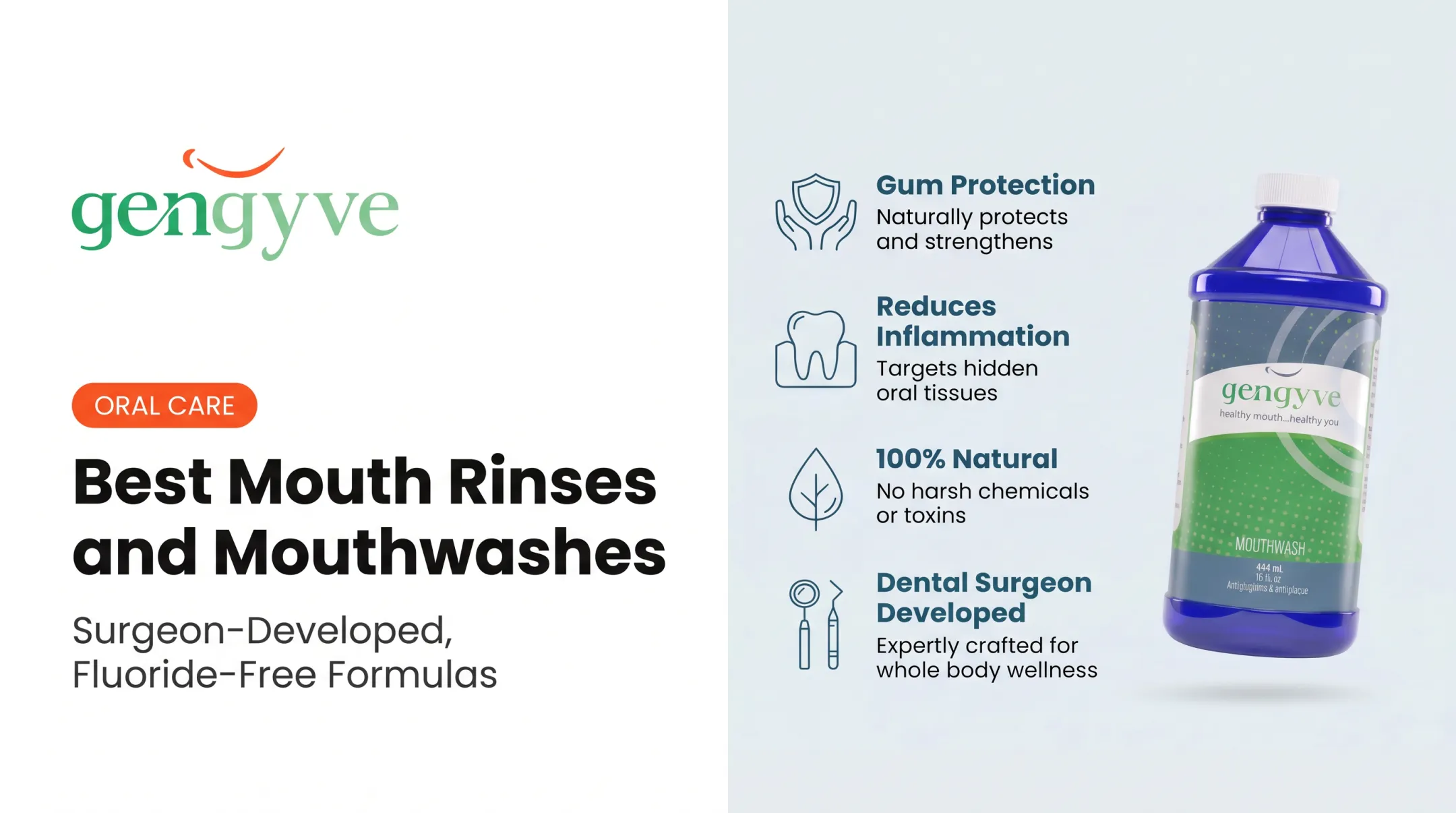
Not every alternative to a harsh rinse needs to be built around tea tree oil. Gengyve, developed by practicing dental surgeons rather than sold as a DIY blend, uses cetylpyridinium chloride (CPC) and hyaluronic acid as its core actives instead of tea tree oil. It's fluoride-free, chlorhexidine-free, and alcohol-free, with pullulan, polyvinylpyrrolidone, and castor oil rounding out the formula.
Independent lab testing through CDR Pharma and Prochemia evaluated its ability to inactivate certain viruses and bacteria, and it carries FDA OTC registration. It does not replace tea tree oil as a category. It shows what "professionally formulated" looks like when a dental surgeon designs a product rather than someone mixing essential oil into water at home.
If your dentist has recommended a fluoride or antimicrobial rinse for a specific condition like active gingivitis, that recommendation should take priority. The right mouthwash depends on your diagnosis and risk factors, not on which bottle says "natural" in the largest font. Be skeptical of any product claiming it "kills all bacteria" or "reverses" disease unless that claim is backed by the label and real clinical evidence.

How Does Tea Tree Oil Compare With Other Natural Oral-Care Options?
Tea tree oil isn't the only plant-based option people reach for. Here's how it compares with other common natural rinses.
| Option | Evidence quality | Practical takeaway |
|---|---|---|
| Tea tree rinse | Mixed, short trials | Possible short-term adjunct; not a treatment |
| Saltwater rinse | Moderate for comfort, low-to-moderate for broader outcomes | Good for soothing, not for clearing infection |
| Aloe vera rinse | Preliminary, described as inconclusive by reviewers | Needs larger studies before firm conclusions |
| Herbal blends | Heterogeneous studies, hard to isolate single ingredients | Results don't transfer reliably between products |
| Oil pulling | Lacking reliable evidence | The American Dental Association does not recommend it as a hygiene method |
Saltwater is a useful comparison point. Rinsing with warm salt water is often recommended for comfort around a healing site, not because it eliminates bacteria or treats an underlying infection. Tea tree oil sits in a similar category: potentially soothing, not curative.
None of these natural options change the fundamentals. You still need:
- Twice-daily brushing with fluoride toothpaste, if that's appropriate for you
- Daily interdental cleaning
- A balanced diet and tobacco avoidance
- Routine dental checkups
When to Stop Home Care and See a Dental Professional
Mouthwash, natural or otherwise, has limits. Certain symptoms mean it's time to stop experimenting at home and get evaluated.
See a dentist if you notice:
- Bleeding that persists beyond a few days
- Swollen, tender, or receding gums
- Pus, a persistent bad taste, or lingering bad breath
- Loose teeth or new tooth sensitivity
- Symptoms that worsen despite consistent brushing and rinsing
Seek urgent care if you have:
- Facial or neck swelling
- Fever alongside dental pain
- Difficulty swallowing or breathing
- A severe, throbbing toothache that worsens when biting down
These last symptoms can point to a dental abscess, and tea tree oil cannot drain an abscess or clear an infection beneath the gum or tooth.
According to the CDC's gum disease guidance, gingivitis is reversible with proper care. Periodontitis is a different, more serious condition that requires professional management rather than home remedies alone.
Diagnosis matters because similar symptoms can come from entirely different causes: gingivitis, periodontitis, a cracked tooth, decay, an implant complication, or even a medication side effect. Each needs a different treatment path. Scaling and root planing, antibiotics when clinically indicated, and restorative work all require a dentist, and no rinse substitutes for them.

That said, a gentle rinse still has a place in supporting recovery. Gengyve, for instance, is designed for use before and after dental procedures and alongside periodontal treatment. The broader point still holds: mouthwash supports a care plan; it doesn't replace one.
Frequently Asked Questions
Is it safe to use tea tree oil as mouthwash?
Only if it's a product specifically formulated and labeled for oral use, used exactly as directed. Never swallow it, and stop immediately if you notice burning or irritation.
Is tea tree oil mouthwash good for you?
It may offer modest antimicrobial or breath benefits in some formulations, but evidence is inconsistent. It works best as an addition to brushing and interdental cleaning, not a replacement for them.
Is tea tree oil good for gingivitis?
Some short studies show improved bleeding or bacterial counts, but it doesn't replace a dentist's diagnosis, professional cleaning, or periodontal treatment when needed.
What is the best mouthwash to reverse gingivitis?
There's no single rinse that works for every case. The right choice depends on the cause, your sensitivity, and your dentist's recommendation, alongside daily plaque removal.
Can oil pulling remove gingivitis?
No. Oil pulling is a different practice from tea tree oil mouthwash, and the American Dental Association doesn't recommend it due to a lack of reliable supporting evidence.
Can tea tree oil heal an abscess?
No. An abscess needs professional treatment, potentially drainage, root canal therapy, or extraction. Swelling, fever, pus, or severe pain calls for urgent dental or medical care, not a home rinse.