That shift makes sense. Gum disease is common among US adults, and many rinses marketed as "gentle" still carry alcohol, artificial dyes, or fragrance blends the label doesn't break down.
Here's the catch: "non-toxic" isn't a regulated term. No agency certifies a mouthwash as officially non-toxic. For this guide, we're using a practical standard: transparent ingredients, no unnecessary irritants, a formula matched to its intended use, and evidence-based oral-health support.
We compared five US mouthwashes against exactly those criteria. None of them replace brushing, interdental cleaning, or a dentist visit. They're one piece of a daily routine, not a fix for gum problems that need a professional look.
Key Takeaways
- Match your rinse to sensitivity, cavity risk, gum concerns, and flavor preference
- Alcohol-free is not always effective; natural is not always gentle; fluoride-free is not for every mouth
- Gengyve USA is a dental-surgeon-developed, alcohol-free, chlorhexidine-free daily rinse worth considering
- See a dentist for persistent bleeding, pain, swelling, ulcers, or dry mouth
Overview of Non-Toxic Mouthwash in the US Market
When people search for "non-toxic mouthwash," they usually mean something specific: alcohol-free, recognizable ingredients, fewer artificial additives, and a gentler feel. Fluoride-free and hydroxyapatite-based formulas often get grouped into the same search, too.



The US market splits roughly into these categories:
- Daily alcohol-free rinses: cosmetic or lightly therapeutic, focused on comfort and breath
- Therapeutic antimicrobial rinses: target plaque and gingivitis with active ingredients like CPC or chlorhexidine
- Fluoride rinses: an anticaries category with decades of decay-prevention data
- Hydroxyapatite formulas: liquid or tablet products built around enamel-mineral particles
- Herbal and essential-oil rinses: plant-derived formulas with widely varying tested results
- Oil-pulling products and dissolvable tablets: format-driven categories, not therapeutic claims on their own
The American Dental Association draws a sharp line here: cosmetic rinses temporarily freshen breath, while therapeutic rinses are formulated and tested for a specific condition, according to ADA's mouthrinse guidance. That distinction matters more than most marketing copy lets on.

It also creates real tension. Someone avoiding fluoride for personal reasons may still have a cavity-prone mouth that benefits from it. Someone with active gum disease may need a clinician-directed rinse, not a fresh-breath product with a "natural" label.
So compare the five options below on formula transparency, intended use, supporting evidence, comfort, packaging, and availability, not on how "natural" the branding sounds.
Best Non-Toxic Mouthwashes
This is a US-focused comparison, not a clinical ranking. Formulas change, so check the current label, directions, and availability before you buy.
Gengyve USA Mouthwash
Gengyve is a Nevada-based oral-care brand built around one question: what mouthwash would a practicing dental surgeon actually recommend to patients?
Founder Dr. S. Thaddeus Connelly, DDS, MD, PhD, FACS, is an oral and maxillofacial surgeon and Full Clinical Professor at UCSF, with more than 60 peer-reviewed publications to his name. He and a co-developing dental surgeon built the formula for both chairside use and daily home care.
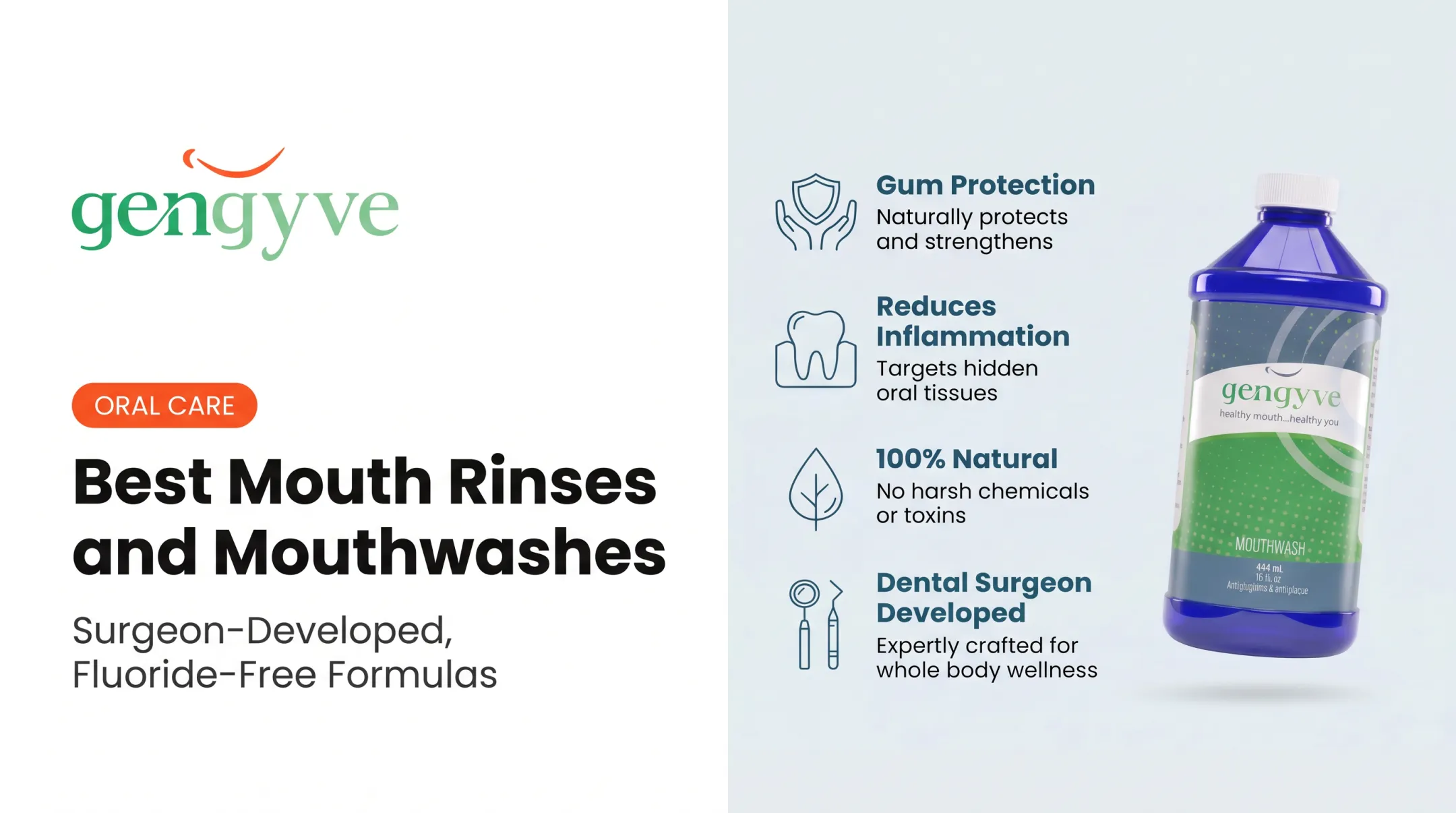
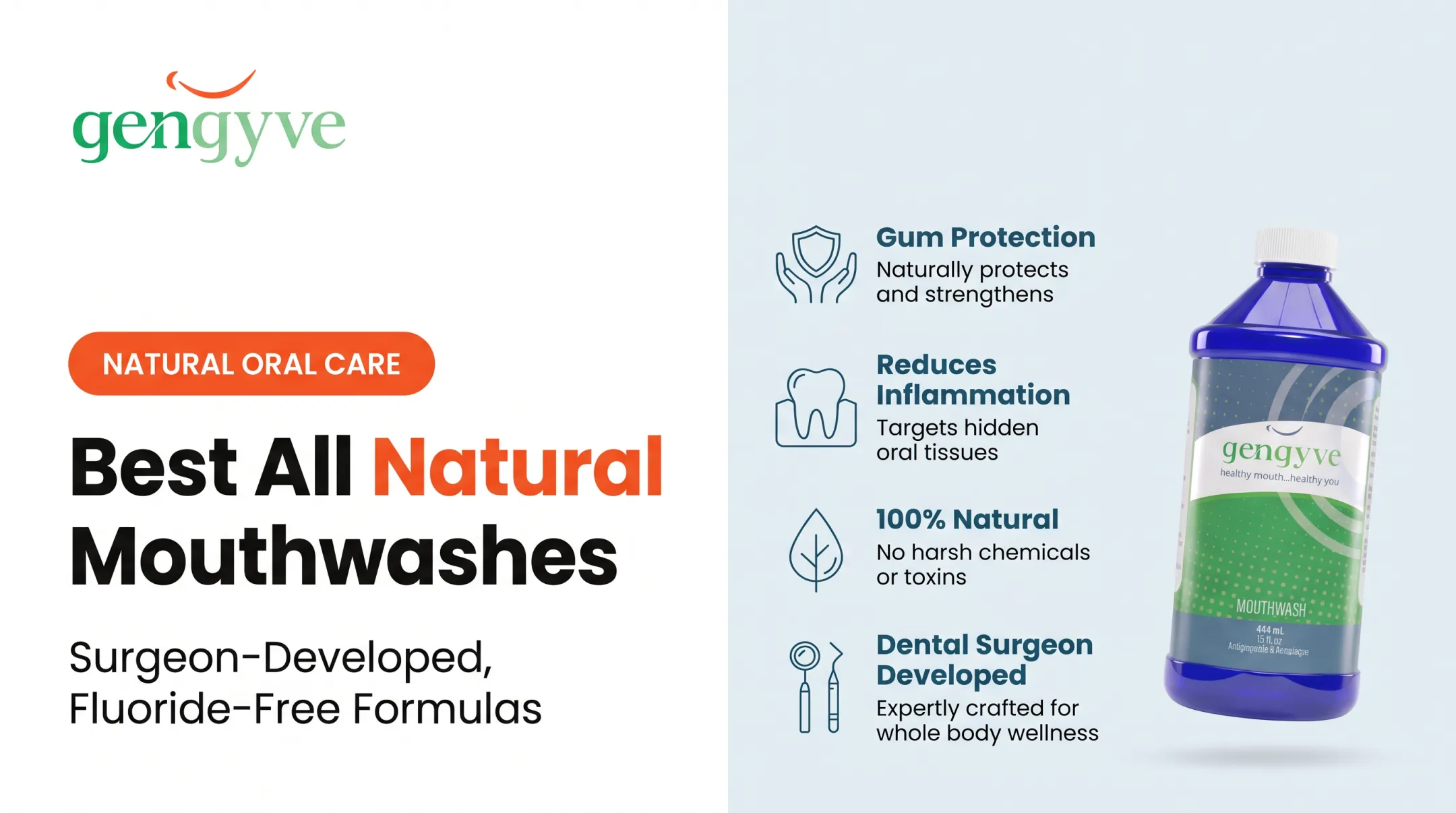
The formula. Gengyve lists cetylpyridinium chloride (CPC), hyaluronic acid, pullulan, polyvinylpyrrolidone (PVP), and castor oil as key ingredients, with the complete list printed on the bottle. It's alcohol-free, fluoride-free, chlorhexidine-free, and free of artificial dyes.
The rinse is FDA-registered as an OTC antigingivitis and antiplaque product (NDC 82161-141, OTC243264R) under the CPC monograph, so it doesn't require a prescription.
What the research shows. A 21-day randomized, double-blind trial compared a CPC-hyaluronic acid rinse, chlorhexidine, and a placebo in 75 dental students. Plaque buildup was worse with the placebo than with either active rinse, though gingivitis differences between groups weren't statistically significant.
That's a useful data point for the ingredient combination. It isn't proof that any single bottle treats existing gum disease, and it doesn't replace a dentist's evaluation.
Who might consider it:
- Adults who want a daily rinse without an alcohol burn
- People managing sensitive gums or early bleeding who've already been checked by a dentist
- Patients whose provider has approved a gentle post-procedure rinse as part of their recovery plan
Post-surgical, oncology, periodontal, and implant patients should still follow their own clinician's specific instructions rather than switching rinses on their own.
| Attribute | Details |
|---|---|
| Formula type | Daily CPC + hyaluronic acid rinse |
| Notable ingredients | CPC, hyaluronic acid, pullulan, PVP, castor oil |
| Alcohol status | Alcohol-free |
| Chlorhexidine status | Chlorhexidine-free |
| Intended use | Daily antigingivitis/antiplaque support |
| Evidence | 21-day RCT on the CPC-HA combination; verify current label for specifics |
| Packaging | 15 fl. oz. (444 mL) bottle; 2 oz. trial size available |
| Purchasing | Direct subscription, trial kit, or wholesale cases ($14.99/bottle, 12-bottle case) for dental practices |
Tom's of Maine Wicked Fresh Mouthwash
Tom's of Maine is one of the most widely available "clean label" mouthwashes in US grocery and drugstore aisles. The Cool Mountain Mint Wicked Fresh! formula (16 oz) lists water, glycerin, sorbitol, propanediol, xylitol, sodium chloride, natural flavor, zinc citrate, benzoic acid, menthol, and sodium hydroxide. It's alcohol-free and fluoride-free.
Zinc citrate is included to neutralize odor, and xylitol serves as the sweetener. Tom's of Maine has been part of Colgate-Palmolive since 2006, which explains the large retail footprint and consistent supply.
Best fit: shoppers who want recognizable ingredients without hunting through a specialty store, plus a strong mint flavor for immediate fresh-breath feedback.
Limitations to weigh:
- No fluoride, so it won't add cavity protection on its own
- Menthol and mint intensity can feel strong for sensitive mouths
- Vegan status isn't confirmed SKU-by-SKU; check the current label if that matters to you
| Attribute | Details |
|---|---|
| Alcohol status | Alcohol-free |
| Fluoride status | Fluoride-free |
| Notable ingredients | Zinc citrate, xylitol, menthol |
| Intended use | Cosmetic fresh-breath daily rinse |
| Packaging | 16 oz bottle |
Lumineux Clean & Fresh Mouthwash
Lumineux's Clean & Fresh formula leans on organic aloe vera leaf juice, xylitol, Dead Sea salt, and a blend of wintergreen, spearmint, peppermint, basil, and clove oils. No fluoride ingredient appears on the current list, and the matching retail listing confirms it's alcohol-free.
The aloe and salt base can feel gentler than a mint-forward rinse, but essential oils aren't automatically non-irritating. Clove and wintergreen oil can still bother people with oral sensitivities or allergies.
On gum-health claims: a manufacturer-hosted report describes a controlled study in 50 subjects over 30 days, finding the Gingival Index dropped 0.41 in the test group versus a 0.02 increase in controls.
That's a useful internal result, but it hasn't appeared in a peer-reviewed journal, and independent certification for this specific SKU wasn't confirmed at the time of research.
Treat Lumineux as a daily-care and fresh-breath option first. For active gingivitis, pair it with a dentist's plan instead of relying on the rinse alone.
| Attribute | Details |
|---|---|
| Alcohol status | Alcohol-free |
| Fluoride status | Not listed in current ingredients |
| Notable ingredients | Aloe vera, Dead Sea salt, clove and wintergreen oils |
| Intended use | Daily fresh-breath rinse with gum-comfort claims |
| Packaging | 16 fl oz bottle |
Olas Marine Bio-Active Mouthwash
Olas takes the botanical approach further than most, blending rosemary, chamomile, myrrh, grapefruit peel, thyme, orange, echinacea, boswellia, cypress, licorice, blue-green algae, and marine seaweed collagen into one alcohol-free, fluoride-free rinse.
The manufacturer attributes antioxidant and anti-inflammatory effects to the marine complex, plus support against plaque-forming bacteria. Those are formulator claims rather than findings from an independent clinical trial on the finished rinse, worth knowing if you're comparing marketing language to actual evidence.
A long ingredient list cuts both ways. It gives Olas a broader plant- and marine-derived profile for people drawn to that positioning, but it also means more components to screen if you have known plant or essential-oil sensitivities.
Packaging varies by size: the 375 mL bottle is marketed as plastic-free, while the 500 mL refill option uses lightweight, BPA-free plastic. The brand lists the product as vegan and cruelty-free.
| Attribute | Details |
|---|---|
| Alcohol status | Alcohol-free |
| Fluoride status | Fluoride-free |
| Notable ingredients | Marine algae complex, rosemary, myrrh, licorice |
| Intended use | Daily rinse with broader botanical positioning |
| Packaging | 375 mL (plastic-free) or 500 mL (BPA-free refill) |
Boka Restore Hydroxyapatite Tablets
Boka's Restore Citrus Mint tablets represent two categories at once: hydroxyapatite rinses and waterless tablet formats. Each tablet uses nano-hydroxyapatite (n-Ha) alongside isomalt, sodium bicarbonate, xylitol, acacia gum, and peppermint and spearmint oils. It's fluoride-free and alcohol-free, packaged in a 90-tablet tin with no plastic bottle.
How it works: chew the tablet, swish with water for at least 30 seconds, then spit. It's the same rinse-and-spit motion as a liquid mouthwash, just without the bottle.

What the evidence actually shows: a 2017 in-situ study used 5% hydroxyapatite microclusters on enamel slabs worn overnight by nine volunteers, finding reduced initial bacterial adhesion compared to no rinse. That's an anti-adhesion finding, not a cavity-prevention outcome, and it didn't test Boka's specific formula.
A 2025 European safety opinion found nano-hydroxyapatite safe in mouthwash up to 10% for specific particle shapes, which is a safety assessment, not proof of fluoride-equivalent cavity protection.
Hydroxyapatite can be a reasonable fluoride alternative for people who prefer it, but it shouldn't be chosen as a guaranteed substitute for fluoride in someone at high cavity risk.
| Attribute | Details |
|---|---|
| Format | Dissolvable tablet (chew, swish, spit) |
| Key ingredient | Nano-hydroxyapatite (n-Ha) |
| Alcohol/fluoride status | Alcohol-free; fluoride-free |
| Packaging | 90 tablets per tin, plastic-free |
How We Chose the Best Non-Toxic Mouthwashes
We built this comparison from product labels, manufacturer documentation, and peer-reviewed or regulatory sources, not testimonials or affiliate rankings.
Ingredient Transparency
We screened each formula for:
- Alcohol, artificial dyes, and undisclosed fragrance blends
- SLS-type surfactants, triclosan, and parabens
- Chlorhexidine, CPC, and other active antimicrobials
- Unnecessary sweeteners beyond what's needed for taste
An ingredient's presence isn't automatic proof of toxicity. Dose, exposure, and individual sensitivity matter more than how unfamiliar a name sounds on the label.
Clinical Purpose and Evidence
We separated cosmetic breath-freshening from products with actual evidence behind plaque, gingivitis, cavity, or dry-mouth claims. When a brand cited research, we checked whether it was independently published, manufacturer-hosted, or backed by an ADA Seal. Those aren't interchangeable levels of proof.

Chlorhexidine is worth a specific mention here. Clinical research shows it reduces plaque and gingivitis as an adjunct to brushing, though extended use raises the risk of external tooth staining. A prescribed chlorhexidine rinse can be exactly right for one patient and a poor daily-use fit for another, depending on the clinical reason it was prescribed.
Safety, Usability, and Limits
We also weighed:
- Alcohol-free status, allergy warnings, and age or pregnancy guidance
- Flavor intensity and reported burning or dryness
- Bottle versus tablet format, packaging material, and price per use
None of the five rinses above remove hardened calculus, reverse advanced periodontal disease, or diagnose the cause of persistent bleeding, pain, ulcers, or dry mouth. Those symptoms call for a dental exam, not a new bottle.
Conclusion
The best non-toxic mouthwash is the one that matches your gum health, sensitivities, and willingness to use it every day. A short ingredient list or a loud "natural" claim alone does not make a rinse right for you.
Here's the short version of what sets these five apart:
- Gengyve USA: a dental-surgeon-developed CPC and hyaluronic-acid rinse, alcohol-free and chlorhexidine-free, built for daily comfort
- Tom's of Maine: widely available, recognizable ingredients, fresh-breath focused
- Lumineux: aloe and essential-oil based, with an internal gum-comfort study
- Olas: a broad botanical and marine-derived blend for plant-forward preferences
- Boka: a hydroxyapatite tablet for travel and waterless routines
Check the label, not just the box copy, before you buy, since formulas and claims change. If you're dealing with active bleeding, pain, swelling, or symptoms after a procedure, talk to a dentist before switching rinses.
If a dental-surgeon-developed, alcohol-free daily rinse sounds like the right fit, Gengyve USA's current formula and product details are worth a look. Just confirm it matches your specific oral-health needs first.
Frequently Asked Questions
What is the most non-toxic mouthwash?
"Most non-toxic" isn't an official clinical category, so there's no single winner. Compare ingredient transparency, intended use, and supporting evidence against your own needs. Gengyve USA is one US option worth evaluating for an alcohol-free, chlorhexidine-free daily rinse, but it's not an automatic universal pick.
What is the healthiest mouthwash in the UK?
This guide focuses on the US market. UK readers should check local formulations, labeling, and availability, since the same brand name can mean a different product overseas. NHS and dental-professional guidance is the right reference point for fluoride and product recommendations there.
What are some non-toxic mouthwash brands?
Based on current, verified formulas, options include Gengyve, Tom's of Maine, Lumineux, Olas, and hydroxyapatite-tablet brands like Boka. Formulas and claims change over time, so always check the current label before buying.
Is alcohol-free mouthwash better for your mouth?
It can be more comfortable for people with dry mouth or irritation-prone tissue. That said, alcohol-free doesn't automatically mean better antimicrobial or cavity-protection performance. A PMC-published trial found alcohol-containing and alcohol-free essential-oil rinses performed similarly for plaque and gingivitis.
Can natural mouthwash help with gingivitis?
Some natural and herbal rinses show plaque and gingivitis benefits in clinical studies, but fresh-breath marketing alone isn't evidence of treatment. Persistent bleeding or inflammation needs a dental evaluation, and mouthwash should supplement, not replace, brushing and interdental cleaning.
Is fluoride-free mouthwash safe and effective?
Fluoride-free formulas suit many personal preferences, but they may not match fluoride's cavity-prevention benefit for people at higher risk. A Cochrane review found fluoride rinses reduced decayed, missing, and filled tooth surfaces by about 27% compared to placebo in children and adolescents. Talk to your dentist before dropping fluoride if you're cavity-prone.