Introduction
Recovering from a tooth extraction, implant placement, or gum procedure often comes with one nagging question: when can you actually rinse your mouth again? An oral rinse can help with comfort and cleanliness during recovery. The right product and timing still depend entirely on your procedure and your surgeon's specific instructions.
Many patients struggle with this balance. You want relief from soreness and a cleaner mouth, but you also don't want to dislodge a healing blood clot, disturb stitches, or disrupt a graft site. Rinse too soon or too aggressively, and you risk setbacks like dry socket or delayed healing.
This guide walks through when rinsing is typically appropriate, what you'll need, how to rinse gently without causing harm, and which symptoms mean it's time to call your dental team instead of troubleshooting on your own.
Key Takeaways
- Follow your dental surgeon's exact instructions on rinse timing, not generic advice found online
- Avoid rinsing, forceful swishing, or hard spitting until your surgical team clears you to start
- Use only the approved rinse, whether that's warm salt water or a specific prescribed or clinician-approved product
- Rinse gently and skip alcohol-based products unless approved
- Contact your dentist if pain, bleeding, swelling, or fever worsens
When Should You Use an Oral Rinse After Surgery?
There's no single "day one" rule for postoperative rinsing. Timing depends heavily on what procedure you had.



- Tooth extraction: Most instructions delay rinsing until the day after surgery
- Dental implant placement: Antiseptic rinsing may begin within 24 hours for routine cases, per surgeon guidance
- Periodontal surgery: Some protocols allow rinsing on the day of surgery itself
- Grafts or complex regenerative work: These often require a longer, more structured antiseptic course, sometimes extending a week or more
This variation exists because early rinsing can interfere with healing. After an extraction, a blood clot forms in the socket to protect the exposed bone and nerve endings underneath. Vigorous swishing or forceful spitting can dislodge that clot, a condition clinicians call dry socket.
Cochrane's 2022 review looked at chlorhexidine rinsing starting 24 hours after extraction, not immediate postoperative swishing. That evidence is why "wait until cleared" matters more than any specific product.

A rinse also isn't a workaround for other problems. Don't use it to mask worsening pain, replace a prescribed antibiotic, or aggressively "flush out" a surgical site that feels off. If something feels wrong, that's a call to your dentist, not a reason to rinse more.
Timing also varies by surgeon preference. One Virginia-based oral surgeon, Dr. Derick Flint, has patients use a specific alcohol-free rinse after wisdom tooth extractions and dental implants as part of standard aftercare. Individualized protocols like this are common across practices.
Patients with sutures, multiple surgical sites, grafts, implants, or oncology-related oral concerns often need customized timing rather than a generic rule. When in doubt, ask before you rinse.
What You Need Before Using an Oral Rinse
Before you reach for any bottle, get your plan straight. A few essentials make a real difference.
A clear aftercare plan from your clinician. This should spell out:
- When to start rinsing
- Which exact product to use
- How often and for how long
- Whether dilution is needed, or whether rinsing should be avoided entirely for now
The correct rinse and supplies. Not all rinses are interchangeable after surgery. A prescribed medicated rinse differs from a simple warm salt water mix. Using the wrong concentration or temperature can irritate healing tissue.
If salt water is recommended, your clinician will specify the exact ratio. Always avoid hot water, which can worsen swelling and tissue sensitivity.
You'll also want:
- A clean cup dedicated to rinsing
- Lukewarm (never hot) water when applicable
- Enough time to rinse slowly, without rushing or forceful spitting
Supervision where needed. Children, older adults, or anyone prone to swallowing a medicated rinse need extra oversight. Check the product label and your clinician's guidance on swallowing risk and storage, especially for prescription-strength rinses kept at home.

How to Use an Oral Rinse After Surgery
Think of this as a sequence, not a one-time action: protect the site first, use only what's approved, keep every movement gentle, and stop immediately if something feels wrong.
Setup and Preparation
Confirm with your surgical team that rinsing has officially been cleared before doing anything else. Check whether your product is ready to use as-is, needs dilution, or requires mixing a salt-water solution from scratch.
Follow verified instructions exactly. That means no very hot water, no undiluted products unless directed, and no improvised ingredient combinations you found online.
Common setup mistakes include starting too early, grabbing an alcohol-containing mouthwash without clearance, or using a routine hygiene rinse instead of what was actually prescribed for postoperative care.
Initiating Use
Place a small, clinician-recommended amount in your mouth. Avoid directing any pressure, including the stream from pouring, toward the surgical site itself.
The first rinse should feel controlled and gentle, not vigorous. If you feel immediate pain, bleeding, burning, or unusual irritation, stop and spit it out gently right away.
A correct first rinse involves no forceful bubbling or suction and no sharp discomfort. Still, the absence of symptoms does not replace your follow-up appointment or written instructions.
Operating the Rinse Correctly
Use gentle tilting of the head rather than aggressive swishing, particularly after extractions, grafting, implant placement, or suturing. The goal is light movement of liquid, not a vigorous swish-and-slosh motion.
Stick to the prescribed amount, duration, and frequency. Rinsing more often than directed won't speed up healing. It can actually slow it down by repeatedly disturbing fragile tissue.
Unless a product is specifically designed to be swallowed, don't swallow it. Follow label or surgeon directions about eating or drinking afterward too.
Monitoring During Use
Watch for signs that something isn't going as it should:
- Renewed bleeding after the rinse
- Increasing pain rather than gradual improvement
- A burning sensation at the surgical site
- Worsening swelling
AAOMS dry socket guidance lists red flags that need prompt attention: persistent or worsening pain, a foul taste or odor, visible bone in the socket, and pain radiating toward the ear or temple.
Pus-like drainage, fever, or difficulty opening your mouth also warrant a call to your dental team.
If you experience severe bleeding, trouble breathing, or facial swelling that's increasing rapidly, seek urgent medical care rather than waiting for a callback.
Shutting Down or Completing Use
Let the solution leave your mouth gently rather than spitting with force. Some clinicians recommend leaning over a sink or cup and letting gravity do the work instead of actively spitting.
Stop rinsing at your instructed interval, and don't follow it with vigorous brushing, flossing, or probing near the surgical site.
For prescribed rinses, store them properly, measure carefully each time, avoid contaminating the bottle, and never share your prescription with anyone else.

Best Practices for Using an Oral Rinse Effectively
Your surgeon's written and verbal instructions override general advice, including anything on a product label or a dental website like this one. If the two conflict, the surgeon's plan wins every time.
A few habits make recovery smoother:
- Keep routine brushing and flossing going around, not directly over, the surgical area once your dentist permits it
- Ask specifically when brushing, flossing, water flossers, or interdental cleaners can resume near the site
- Avoid smoking, vaping, alcohol, and straws if your surgical team has prohibited them. These restrictions support healing; they're not something a rinse can substitute for
- Don't assume "natural" automatically means safe post-surgery. Check ingredients, concentration, personal allergies, medication interactions, and compatibility with any grafts or implants
On alcohol-based mouthwash specifically: alcohol can dry and irritate already-healing tissue, which is why it's typically avoided unless your dentist says otherwise. The American Cancer Society's guidance on oral care during treatment similarly steers patients with sensitive or healing oral tissue away from alcohol-containing rinses in favor of bland, non-irritating options.
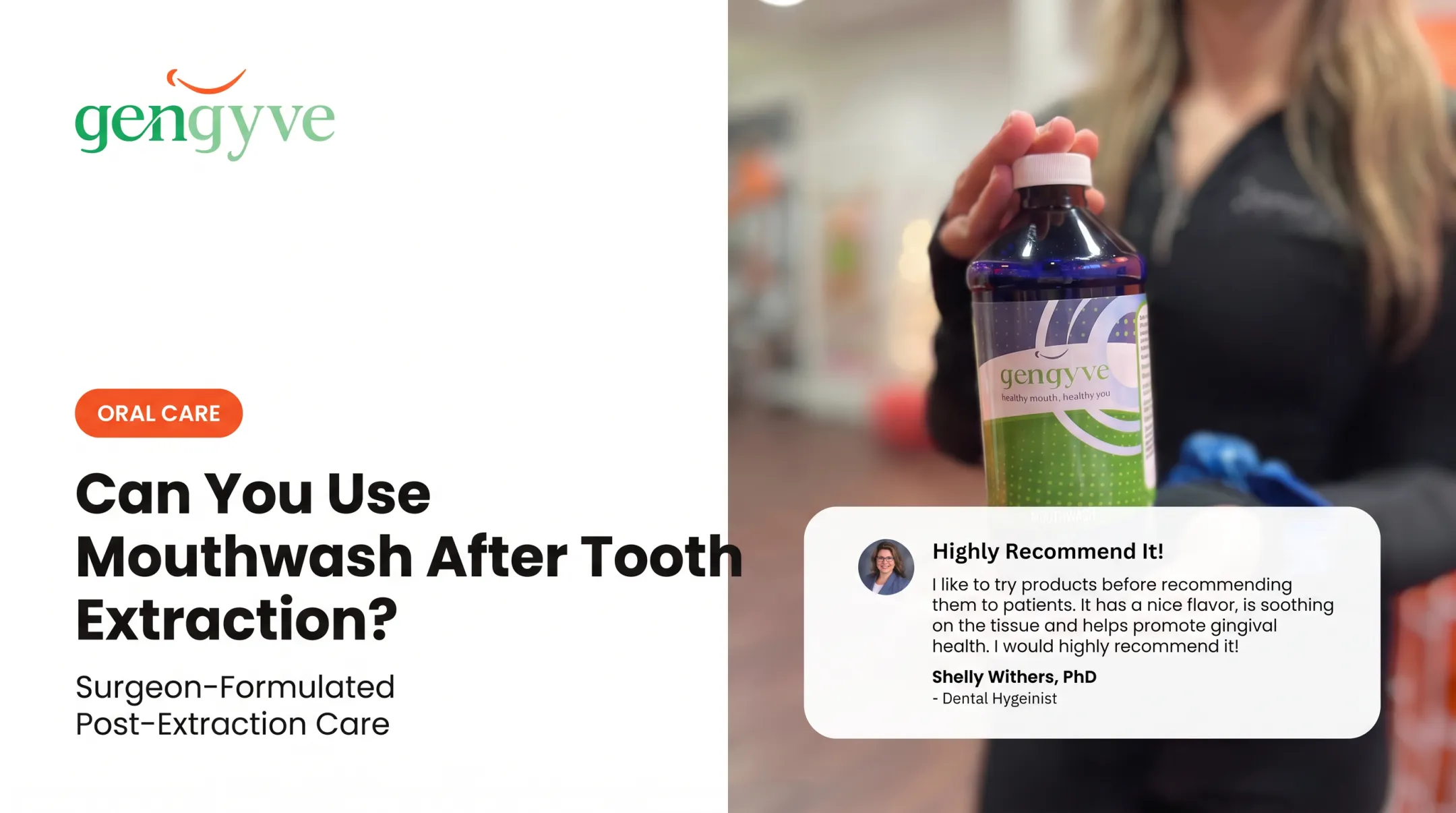
If your clinician approves an alcohol-free option for post-surgical use, several formulations exist. Gengyve, developed by Dr. S. Thaddeus Connelly, an oral and maxillofacial surgeon and UCSF clinical professor, is formulated without alcohol, fluoride, or chlorhexidine. It uses cetylpyridinium chloride and hyaluronic acid.
The company's instructions call for use one day before surgery, then a 60-second rinse twice daily afterward for as long as needed, with no water rinse required. Discuss this with your dental professional; it is not a substitute for whatever your surgeon has prescribed.
A 21-day trial comparing a CPC-hyaluronic acid rinse, chlorhexidine, and a placebo among dental students found comparable plaque reduction and no notable staining increase in the CPC-hyaluronic acid group. That study does not establish superiority or address long-term surgical outcomes.
Conclusion
Getting postoperative rinsing right comes down to following the correct timing, solution, technique, and frequency for your specific procedure.
Protect your healing site, skip forceful rinsing and spitting until you're cleared, and call your dentist or oral surgeon the moment symptoms worsen or instructions feel unclear. When recovery questions come up, your surgical team's guidance always takes priority over what you read anywhere else, including here.
Frequently Asked Questions
What is the recommended oral rinse after oral surgery?
It depends entirely on your procedure and your clinician's plan. Approved options may include warm salt water or a specific prescribed or clinician-approved rinse, so always confirm with your dental team before choosing one.
Can I rinse my mouth before oral surgery?
Follow your dental team's pre-operative instructions, especially if fasting, a specific antiseptic rinse, or medication timing is involved. Some surgeons recommend a particular rinse the day before surgery, so ask directly.
How long is recovery after oral surgery?
Recovery timelines vary based on the procedure, surgical complexity, your overall health, and how your body heals. Follow the specific timeline your clinician gives you and report any symptoms that worsen instead of improve.
When can I rinse my mouth after oral surgery?
Wait until your dentist or oral surgeon explicitly says it's safe. Rinsing too early can disturb a healing blood clot, loosen stitches, or disrupt a graft or implant site.
Can I use alcohol-based mouthwash after oral surgery?
Not unless your treating dental professional specifically approves it. Alcohol-based products can dry out and irritate tissue that's still healing, which may slow recovery or cause discomfort.