Introduction
A mouthwash can leave your mouth feeling clean and your breath smelling fresh. You may still wonder why your teeth look duller, or why that bright blue rinse left a faint tint behind.
Many users struggle to tell the difference between a product that's actually staining their teeth and one that's simply clearing plaque and bacteria.
This guide has two jobs. First, it identifies mouthwashes less likely to contribute to surface stains in the first place. Second, it looks at which rinses may help with stains you already have, typically the kind caused by coffee, tea, wine, or tobacco.
We're judging each option by ingredient profile, stain risk, gum-health benefit, sensitivity, available evidence, and whether it's realistic for daily use. Some products reduce staining risk by what they leave out. Others attempt gentle whitening. None of them replace a dental cleaning.
Key Takeaways
- "Best" depends on your goal: stain prevention, stain removal, gum support, or avoiding alcohol and a harsh burn
- Chlorhexidine can cause temporary brown staining and belongs under a dentist's direction, not routine self-care
- Scan labels for dyes, peroxide, alcohol, fluoride, CPC, chlorhexidine, and zinc combinations before buying
- Mouthwash can't dissolve tartar or change the color of tooth structure itself; brushing, flossing, and dental visits still matter
Overview of Stain-Conscious Mouthwash in the US Oral-Care Market
Not all tooth discoloration comes from the same place, and that distinction matters when you're shopping for a mouthwash.


Extrinsic stains sit on the tooth surface. They come from food, drinks, tobacco, plaque, tartar, dyes, or certain oral-care ingredients themselves. Intrinsic discoloration lives inside the enamel and dentin, and no rinse, "non-staining" or otherwise, changes that.
A mouthwash labeled "non-staining" usually just means it skips coloring agents and known stain-associated ingredients. A "whitening" rinse is a different claim entirely. It typically uses peroxide to gradually lift some surface stains over weeks, not days.

Here's what matters most when you're scanning ingredients:
| Ingredient | What it does | Stain or comfort concern |
|---|---|---|
| Chlorhexidine | Prescription antimicrobial | Documented brown staining risk |
| CPC (sometimes paired with zinc) | OTC antimicrobial, plaque control | Staining possible with longer-term use |
| Hydrogen peroxide | Oxidizes stain molecules | May increase sensitivity |
| Fluoride | Prevents cavities | Not a whitening agent |
| Alcohol | Carrier or antiseptic | Can dry out or irritate tissue |
According to ADA's mouthrinse guidance, CPC-containing rinses can cause brown staining of teeth, tongue, or restorations in some users, particularly with longer-term use. That doesn't make CPC a bad ingredient. It just means "antimicrobial" and "non-staining" aren't automatically the same thing.
The products below represent different use cases, not one universal winner. Compare the current label on anything you buy, and see a dentist if staining or gum symptoms don't improve with routine hygiene.
Best Stain Mouthwashes for US Consumers
We picked these five based on:
- Low staining potential tied to verified ingredients
- Dye-free or transparent-formula status where confirmed
- Evidence-backed active ingredients, not just sensory marketing
- A clear match between the product and a specific goal
- Tolerability for sensitive mouths
- Followable, unambiguous directions
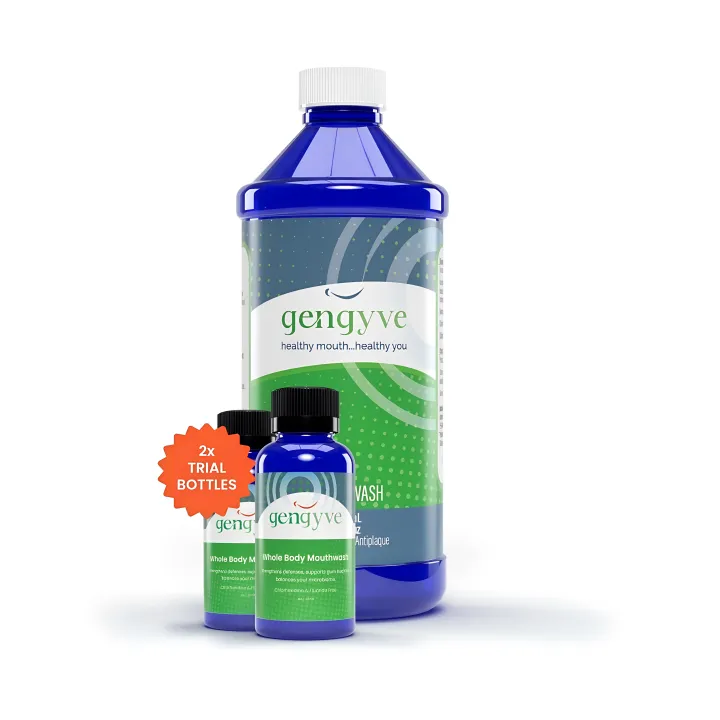
Gengyve Mouthwash
Gengyve is a US-developed mouthwash created by Dr. S. Thaddeus Connelly, an oral and maxillofacial surgeon who serves as a Full Clinical Professor at UCSF and as staff surgeon and residency director at the San Francisco VA.
He and a research partner built the formula after deciding that no existing rinse met the standard they wanted for their own patients. That background shapes the positioning, not the evidence itself, so check the current labeling and ingredient list yourself before assuming any specific claim.
What sets it apart on paper:
- Alcohol-free and chlorhexidine-free, built around cetylpyridinium chloride (CPC) and hyaluronic acid
- No artificial dyes, according to the company's own product FAQ
- Marketed as gentle enough for daily use, without the burn associated with alcohol-based rinses
- A 21-day randomized trial found no significant staining increase with CPC-hyaluronic acid, unlike the chlorhexidine and placebo groups
- Short study window: 21 days alone does not establish long-term stain results
Product snapshot:
- Stain profile: Dye-free by company claim. CPC-based formulas still warrant a label check, since CPC itself carries some documented staining risk with longer-term use
- Best suited for: Readers wanting gentle daily gum support, an alcohol-free routine, or a dental-surgeon-developed option over a mass-market rinse
- Limitation: Gum-support benefits aren't the same as stain removal. Confirm current CPC concentration and any stain-related claims before assuming this addresses existing discoloration
Colgate Optic White Mouthwash
Colgate's Optic White Whitening Mouthwash lists hydrogen peroxide, at 2% on the product's own page, as its active whitening ingredient. That puts it in the gradual surface-stain category rather than anything that reshapes enamel color from within.
A 2025 randomized trial testing a 2.5% peroxide rinse found measurable color change only after 60 days of use, according to the 2025 clinical trial. Sensitivity was minimal in that study.
The takeaway holds across peroxide rinses generally: they work on a timeline measured in months, not days, and results from one concentration don't automatically map onto every product on the shelf.
Product snapshot:
- Stain profile: Contains 2% hydrogen peroxide. Manufacturer claims surface-stain whitening, future-stain prevention, and an alcohol-free base
- Best suited for: People with coffee-, tea-, or wine-related surface staining who want a gradual, low-effort addition to their routine
- Cautions: Follow label directions exactly. Deeper or uneven discoloration usually needs professional whitening or a dentist's evaluation, not a stronger rinse
Crest 3D White Brilliance Pro
Crest's whitening lineup includes several SKUs, but Brilliance Pro Rinse is positioned most directly around stain reduction. Its FDA drug-facts label lists sodium fluoride 0.02% (0.01% fluoride ion) as the anticavity active, plus hydrogen peroxide for whitening, though the peroxide concentration isn't disclosed on the label.
That fluoride inclusion means this rinse does double duty: cavity prevention plus cosmetic whitening. The label directs ages 12 and up to rinse with 10 mL for one minute, twice daily after brushing.
Then avoid food or drink for 30 minutes, a step that's easy to skip but affects how well the peroxide works.
Product snapshot:
- Stain profile: Fluoride plus peroxide combination, alcohol-free. Manufacturer claims "whiter teeth in 7 days" based on its own testing
- Best suited for: Readers who want one rinse handling both cavity protection and gradual surface-stain whitening
- Cautions: Manufacturer claims aren't independent verification. Watch for sensitivity if you're also using whitening toothpaste or strips, and avoid stacking multiple peroxide products without dental advice
CloSYS Ultra Sensitive
CloSYS Ultra Sensitive skips the two ingredients most associated with irritation: dye and alcohol. The formula centers on stabilized chlorine dioxide (the company calls it Cloralstan), plus trisodium phosphate and citric acid, and the company describes it as pH-balanced.
None of that is a whitening claim. CloSYS isn't positioned to remove stains. It's positioned to not add to the problem while staying gentle enough for mouths that can't tolerate a strong mint burn or a drying alcohol base.
Product snapshot:
- Stain profile: Dye-free and alcohol-free by manufacturer claim. A gentle formula isn't proof of whitening performance
- Best suited for: People with sensitivity, dry mouth, or irritation from standard rinses
- Cautions: Supports comfort and hygiene, but won't remove tartar, treat gum disease, or reverse set-in discoloration. For dry mouth as the main issue, compare CloSYS's dedicated dry-mouth formula
Dentist-Directed Chlorhexidine Rinse
Chlorhexidine belongs on this list as a comparison point, not a recommendation for daily cosmetic use. It's prescription-only in the US, and the label indicates it for treating gingivitis under a dentist's program, not periodontitis and not cosmetic staining.
The staining data is well documented. In the six-month trial behind the FDA's Peridex label, measurable anterior staining appeared in 56% of chlorhexidine users versus 35% of controls, and heavy staining showed up in 15% of users versus 1% of controls.
The same label notes the stain can usually be removed from most tooth surfaces through professional cleaning. Reversible, but not subtle.
Other documented effects include altered taste, increased tartar buildup, and occasional hypersensitivity.
Product snapshot:
- Stain profile: The highest staining risk among the options here, a known trade-off rather than a rare side effect
- Best suited for: Short-term, dentist-directed use for specific gum, surgical, or infection-related needs
- Cautions: Don't self-prescribe this for cosmetic reasons. Follow the exact course your dentist sets, and call them if staining, taste changes, or irritation become bothersome

How We Chose the Best Stain Mouthwashes
A burning sensation doesn't mean a rinse works harder. A bright color doesn't mean a formula is more effective, and a flood of five-star reviews doesn't verify an ingredient list. We filtered out marketing noise and focused on verifiable facts.
Ingredient and stain-risk criteria:
- Checked for chlorhexidine, CPC, zinc salts, peroxide, alcohol, dyes, fluoride, and essential oils
- Noted links to staining, sensitivity, dryness, or gum benefits for each ingredient
- Separated real staining evidence from marketing claims about freshness, plaque control, or "natural" formulas
Evidence and product-quality criteria:
- Verified current US labels, manufacturer directions, and ADA Seal of Acceptance status where it applied
- Required clinical research on the specific product, not just the active ingredient in general
- Excluded statistics that couldn't be confirmed or didn't apply to the product in question
Use-case and safety criteria:
- Matched each rinse to a clear goal: stain prevention, extrinsic stain treatment, gum support, cavity prevention, or relief from sensitivity and dryness
- Flagged dentist-referral triggers such as persistent bleeding, pain, swelling, sudden discoloration, severe sensitivity, visible tartar, oral lesions, or stains that don't clear with normal hygiene
Usage criteria:
- Required clear measured dose and timing on the label, not vague "rinse as needed" directions
- Confirmed warnings against swallowing and against rinsing away an active early unless the label says to
- Treated mouthwash as a supplement to fluoride toothpaste and interdental cleaning, never a replacement

Conclusion
The best stain-conscious mouthwash is the one that matches what you're actually trying to fix, backed by an ingredient list you've checked.
Match the rinse to the job:
- Gentle, alcohol-free, chlorhexidine-free daily care with dental-surgeon input: Gengyve fits that use case if you confirm the current formula first; treat it as gum support, not a stain-removal product
- Coffee or wine stains: a peroxide rinse is the more relevant tool
- Chlorhexidine needs: that call belongs to your dentist, not a shelf label
Persistent discoloration that doesn't respond to routine hygiene deserves a professional look, not another bottle. Readers or dental practices curious about Gengyve's formulation and wholesale options can find current product details through the company's own channels.
Frequently Asked Questions
What is the best non-staining mouthwash?
It depends on the formula in front of you. Look for dye-free, alcohol-free options without chlorhexidine, and remember that "non-staining" and "whitening" are two different claims that shouldn't be confused.
Do mouthwashes stain teeth?
Some can, mainly through chlorhexidine, artificial dyes, or long-term CPC use. Most dye-free, alcohol-free rinses used as directed don't cause visible staining.
Why is my mouthwash staining my teeth?
Common causes include chlorhexidine, colored dyes, or existing plaque and tartar reacting with ingredients. Coffee, tea, and tobacco use can compound the effect. See a dentist if it persists.
What mouthwash can help prevent teeth stains?
Check your current label for dyes and stain-associated ingredients like chlorhexidine. Brushing, flossing, limiting staining foods and tobacco, and regular cleanings matter more than any single rinse.
What is the best mouthwash to remove stains from my teeth?
Peroxide-based whitening rinses may help with some extrinsic stains from coffee, tea, or wine, but they can't remove tartar or change intrinsic tooth color. Professional whitening handles deeper discoloration.
What is the best mouthwash for treating gum disease?
It depends on severity. Some therapeutic rinses are used only under dental supervision, and no mouthwash replaces periodontal assessment, professional cleaning, brushing, or interdental care.