Introduction
You brush your teeth twice a day, every day, for years. Few people ever flip the toothbrush over and ask what the bristles are actually made from.
Most conventional toothbrushes use nylon or PBT (polybutylene terephthalate) bristles. These are synthetic polymers, and recent lab studies have found that the friction from brushing can cause tiny fragments to break off.
This article won't tell you to panic or to toss your toothbrush in the trash tonight. Instead, it separates what researchers have actually measured from what remains unknown, then gives you a practical framework for choosing a lower-plastic toothbrush without sacrificing your oral health.
Key Takeaways
- Bristle material, not handle material, determines whether a toothbrush sheds plastic particles
- A bamboo handle doesn't make a brush microplastic-free if the bristles are still nylon
- Bio-based nylon bristles reduce fossil-fuel inputs but still shed plastic
- Natural animal-hair bristles may avoid synthetic shedding, but come with their own tradeoffs
- Keep brushing twice daily and replace your brush on schedule regardless of material choice


What Does the Research Say About Microplastics From Toothbrushes?
Defining the Terms
Microplastics are plastic particles smaller than 5 millimeters, according to NOAA's marine debris primer. Nanoplastics are a much smaller subset, generally under 100 nanometers, though that boundary isn't universally agreed upon across scientific bodies. This matters because a visible bristle fragment is a different category than the microscopic particles researchers detect under a microscope or with Raman spectroscopy.
What Mechanical Brushing Does to Bristles
Bristles flex thousands of times per brushing session. Add moisture, temperature swings, and brushing pressure, and you get repeated mechanical stress on the polymer structure. That stress is the proposed mechanism behind particle shedding, though researchers are still working out exactly how much pressure or how many brushing cycles it takes.
What the Studies Actually Found
Three recent studies illustrate how differently this gets measured:
- Fang et al. (2023) pressed cleaned bristles against a glass slide for about three minutes (no brushing motion or toothpaste) and used Raman imaging to identify polyamide particles from small slide subareas.
- Wang et al. (2025) simulated brushing in artificial saliva at 2 Newtons and 37°C, estimating 7,188–15,560 polypropylene, 10,440–10,810 polyamide, and 7,521–8,104 PET particles per use, per Wang's 2025 study.
- Ozturk Aytulun et al. (2025) brushed a 3D-printed dental arch twice daily for seven days and found particles from 8 to 1,995 micrometers.

Wang's figures are scenario spans under specific lab conditions, not a universal dose. None of these setups match how you actually brush at your bathroom sink. Bristle stiffness, brushing force, water temperature, and lab-versus-real-world methods all change the numbers.
Release Isn't the Same as Harm
One distinction often lost in headlines: detecting particles released from a bristle under lab conditions is not the same as proving someone swallowed them, absorbed them, or got sick from them. None of the studies above measured human exposure or health outcomes. They measured release under controlled conditions.
The American Dental Association addressed this directly. Anita Mark of the ADA Library & Archives wrote that the profession is "still waiting for more studies on the relationship between microplastics and oral health care products," according to ADA's 2026 guidance.
That statement cuts both ways: it doesn't prove toothbrushes are dangerous, and it doesn't prove they're safe. The ADA's practical advice hasn't changed: brush twice daily for two minutes with soft bristles, and don't scale back your routine over microplastic concerns.
Which Toothbrush Materials Are Most Likely to Reduce Plastic Exposure?
Choosing a lower-plastic toothbrush means evaluating the whole product, not just the part you see in marketing photos.
The Bamboo Handle Doesn't Answer the Bristle Question
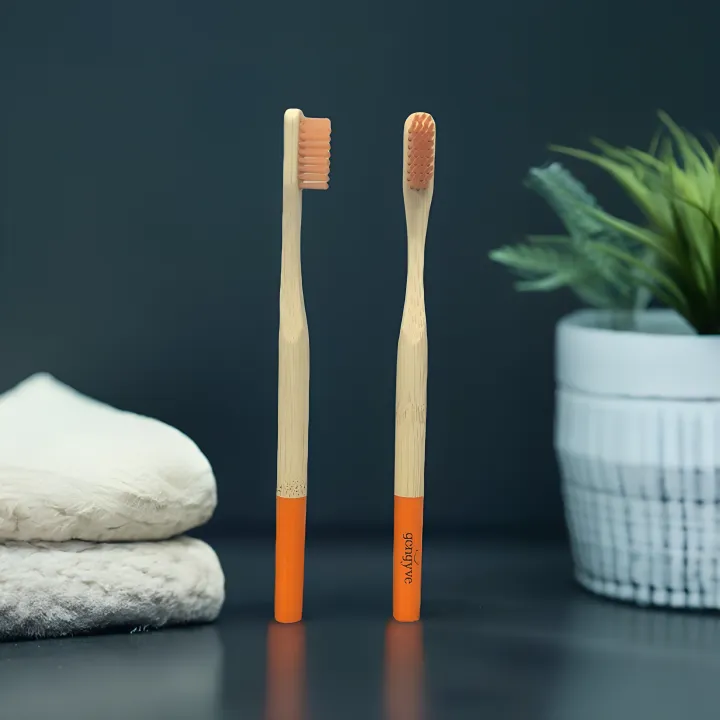
This is the single most important distinction to understand. A bamboo toothbrush typically describes the handle, not the bristles. One documented bamboo-brush example uses nylon filaments (specifically PA1010) tufted into the bamboo head. Composting the handle at end of life doesn't change what the bristles were made from while you used them.
Bio-Based Bristles: Renewable Feedstock, Not Automatically Plastic-Free
Castor-oil-derived bristles are often marketed as a greener choice, and the renewable sourcing angle is real. But chemically, castor-derived monomers get polymerized into PA1010, which is still nylon.
"Bio-based" describes where the raw material came from, not whether the finished bristle is plastic or whether it sheds fewer particles than conventional nylon. No published study has established a verified lower-shedding benchmark for bio-based bristles versus standard nylon.
Natural Animal-Hair Bristles: Real Tradeoffs
Boar- and horse-hair bristles avoid synthetic polymer entirely, which appeals to anyone trying to minimize plastic exposure. But they come with genuine considerations:
- Stiffness: natural bristles can be too firm for some mouths, risking gum irritation
- Drying time: natural materials may take longer to dry than nylon, and damp bristles can support bacterial growth
- Hygiene: a 2020 Microorganisms study found similar bacterial counts on nylon and pig-bristle brushes, undercutting blanket claims that animal hair is less sanitary
- Sourcing and suitability: ethical sourcing questions and firmness variability make them less predictable, especially for children
Electric Brush Heads Deserve a Separate Look
An electric toothbrush handle can be reusable or repairable for years. The replaceable head, though, is a different story: it typically still contains synthetic bristles and mixed plastic components. Swapping to electric doesn't automatically solve the bristle-material question.
Before buying anything labeled "eco" or "non-toxic," check the manufacturer's documentation for actual bristle composition. Unsupported claims like "zero plastic" or "microplastic-free" mean little without disclosed materials or testing behind them.

How to Choose a Lower-Microplastic Toothbrush
A Practical Buying Checklist
- Identify the bristle material first: look for "nylon," "PBT," "PA1010," or "natural/animal hair" on the packaging or product page
- Inspect the handle separately: bamboo, wood, or recycled plastic handles don't tell you anything about the bristles
- Check adhesives and brush-head components: some "plastic-free" brushes still use plastic to anchor bristles into the head
- Read the end-of-life instructions: does the brand tell you how to separate materials for disposal, or does it stay vague?
Decoding the Label Language
These terms get used interchangeably in marketing, but they mean different things:
| Claim | What it actually requires |
|---|---|
| Biodegradable | Complete breakdown within about a year under normal disposal, per the FTC's Green Guides |
| Compostable | All materials become usable compost; home vs. industrial composting matters |
| Bio-based | Feedstock is renewable; says nothing about plastic content or shedding |
| Plastic-free | No plastic in the item as described; doesn't apply to substitute materials with similar environmental risks |
| Microplastic-free | No standardized certification exists for this claim on toothbrushes today |
Matching Material to Your Mouth
Soft or appropriately gentle bristles and a head size that reaches your back molars matter more day-to-day than the plastic question alone. If you have gum recession, sensitivity, orthodontic appliances, implants, or active gum disease, talk to your dentist before switching bristle types. A stiffer "natural" bristle isn't automatically better for you.
Weighing Your Options
- Natural animal-hair bristles minimize synthetic plastic but trade off on firmness consistency and drying time
- Bio-based bristles use renewable feedstock with unresolved shedding questions
- Conventional nylon offers familiar, predictable performance with the plastic-shedding concerns discussed above
Whatever you choose, weigh it against plaque removal, comfort, price, availability, and your ability to keep it clean. A toothbrush that cleans poorly because it's uncomfortable doesn't help anyone, regardless of what it's made from.
Practical Ways to Reduce Exposure Without Compromising Oral Hygiene
You don't need to overhaul your entire routine to make meaningful changes. A few habits help regardless of bristle material:
- Brush gently: excess pressure accelerates bristle wear and may increase fragment release
- Rinse after every use: store the brush upright with airflow, not capped or enclosed
- Replace on schedule: every three to four months, or sooner if bristles look splayed or matted
Here's a common misconception worth correcting: keeping a toothbrush longer than recommended isn't a smart exposure-reduction hack. Worn bristles clean less effectively and can irritate gums, which trades one problem for a worse one.
Beyond the toothbrush itself, small swaps across your routine add up. Choosing products like Gengyve USA's dental-surgeon-developed, alcohol-free mouthwash for a gentler rinse is a reasonable addition for anyone sensitive to harsh formulas. A gentle mouthwash does not prevent bristle shedding or replace brushing and interdental cleaning. Treat it as a complement to those habits, not a substitute.
Conclusion: Choose Transparency Over Toothbrush Marketing
Synthetic bristles can shed particles under laboratory brushing conditions. That much is documented. What remains genuinely unresolved is how much of that release translates into real human exposure, and whether that exposure causes measurable harm.
The most defensible approach when shopping:
- Inspect the actual bristle material before anything else
- Question vague environmental claims
- Prioritize bristles gentle enough for effective cleaning
- Favor brands willing to disclose their sourcing and testing
If you want to make a swap, do it gradually and keep your dental fundamentals intact. Brush twice daily, clean between your teeth, and ask your dentist about what fits your specific mouth. A thoughtful material choice and solid oral hygiene aren't competing priorities. They work together.
Frequently Asked Questions
What is the best toothbrush to use to avoid microplastics?
A toothbrush with verified natural, non-synthetic bristles, such as boar or horse hair, minimizes synthetic plastic exposure. Weigh that against firmness, hygiene upkeep, and whether animal-derived bristles suit your dental needs.
Do all toothbrushes release microplastics?
Studies have found particle shedding from several tested synthetic-bristle toothbrushes, but results vary widely by material and test conditions. No research has proven that every toothbrush on the market releases a harmful amount.
Are bamboo toothbrushes free from microplastics?
Usually not. "Bamboo" typically describes the handle only, and many bamboo toothbrushes still use nylon or other synthetic bristles at the brushing surface where it matters most.
Are castor-oil toothbrush bristles plastic-free?
No. Castor oil is used to make a bio-based nylon called PA1010. It reduces fossil-fuel inputs but is still a synthetic polymer and isn't automatically proven to shed fewer particles.
Can microplastics from toothbrushes make you sick?
Current research shows particles can be released under lab conditions, but that's different from proving toothbrush-specific disease in humans. Long-term health effects and real-world exposure significance remain under active study.
How often should I replace a toothbrush if I am worried about microplastics?
Follow standard dental guidance: replace every three to four months, or sooner if bristles look worn or splayed. Using a brush longer than recommended isn't a reliable way to reduce exposure and can harm your gums instead.