Current evidence does not establish that alcohol-containing mouthwash causes oral cancer. That's not the same as saying it's been proven safe beyond all doubt—it means the research hasn't found a clear, consistent link, despite decades of looking.
Part of the confusion comes from mixing up three different things: alcohol in a mouthwash, drinking alcoholic beverages, and newer research on oral microbiome changes. These topics get tangled together online, but they're not interchangeable evidence.
This article walks through what the research actually shows, which risk factors have solid evidence behind them, how to pick a mouthwash that fits your needs, and which symptoms should send you to a dentist regardless of what's in your rinse.
Key Takeaways
- No reliable research currently proves routine alcohol mouthwash use causes oral cancer
- Tobacco, heavy alcohol consumption, and certain HPV infections have far stronger evidence as oral-cancer risks
- Alcohol-free mouthwash often suits people with dry mouth, burning, or sensitive tissue better
- Mouthwash works alongside brushing and flossing, never as a replacement for either
- Persistent mouth sores, lumps, or patches always need professional evaluation
What Does the Research Say About Alcohol Mouthwash and Oral Cancer?
The concern traces back to a plausible-sounding theory: alcohol exposes oral tissue to ethanol, which could dry or irritate the mouth lining. Repeated irritation, in theory, might eventually promote abnormal cell changes. That's a mechanism worth studying, but a mechanism isn't proof of cancer causation.


What the studies actually found
Researchers have tried to test this theory for over a decade, with mixed results.
A large pooled analysis from the International Head and Neck Cancer Epidemiology Consortium reviewed 12 case-control studies covering nearly 9,000 cancer cases. Ever-using mouthwash showed essentially no association (odds ratio 1.01). More-than-once-daily use showed a modest increase (OR 1.31), but investigators couldn't reliably separate alcohol-containing rinses from alcohol-free ones in that signal.
A more recent systematic review and meta-analysis examined 15 case-control studies with over 6,500 cancer cases. The results:
- Overall mouthwash use: no significant association (OR 1.00)
- Alcohol-containing mouthwash specifically: no significant association (OR 1.20, confidence interval crossing 1.0)
- Three-or-more-daily-uses: a notable increase (OR 2.58), but based on very few studies
That last finding matters, but it's thin. A handful of studies showing a frequency-based signal doesn't rise to the level of "mouthwash causes cancer." It raises a question for further research, which is exactly how the American Cancer Society frames it: some studies suggest a possible link with heavy mouthwash use, while other research questions those same results.

The microbiome studies: a different question entirely
You may have seen a 2024 study reporting that an alcohol-based mouthwash altered oral bacteria. That study enrolled 59 participants who used the rinse daily for three months, then switched to a placebo for three months. Researchers found two bacterial species became more abundant after the active-rinse period.
That's a real finding about bacterial composition. It is not a finding about cancer. The study didn't track cancer outcomes, didn't collect smoking or dietary data, and involved a narrow, specific population. Equating "bacteria changed" with "cancer risk increased" skips several scientific steps that haven't been taken yet.
Why these studies are hard to interpret
A few limitations show up across almost all of this research:
- Recall bias: participants self-report mouthwash habits from years earlier
- Confounding: smoking and drinking habits often aren't fully separated from mouthwash use
- Incomplete alcohol-content data: studies frequently estimate rather than confirm actual product formulations
- Short follow-up: microbiome studies run for months, not the years needed to observe cancer development
- Small, narrow samples: results may not generalize to the broader population
Mouthwash versus the stronger evidence
The evidence connecting alcohol mouthwash to oral cancer is nowhere near as strong as the evidence for tobacco use or heavy drinking. Treating a rinse-and-spit habit as equivalent to a pack-a-day smoking history or years of heavy drinking isn't supported by the data.
The American Dental Association points to an earlier meta-analysis that found no association between mouthwash use, alcohol content, or dose response and oral cancer, though that review itself is now over a decade old. That age is a reminder to keep watching for newer data rather than treating any single study as the final word.
Bottom line: this remains an active area of study. The available evidence doesn't currently justify the claim that alcohol-containing mouthwash directly causes oral cancer.
What Are the Established Risk Factors for Oral Cancer?
Oral and oropharyngeal cancers affect the lips, tongue, gums, inner cheeks, floor of the mouth, and the throat region including the tonsils and base of the tongue. Different risk factors matter more in different locations, which is part of why blanket statements about "mouth cancer causes" can be misleading.
Tobacco: the clearest established risk
Cigarettes, cigars, pipes, chewing tobacco, snuff, and dip all carry well-documented risk. This isn't a close call in the research: it's one of the most consistently reproduced findings in cancer epidemiology. If you use any tobacco product, cessation support (not a mouthwash swap) is the single most impactful step available.
Alcohol consumption: the beverages, not the rinse
Here's where the distinction really matters. Drinking alcoholic beverages, especially moderate-to-heavy drinking, raises oral-cancer risk. According to the American Cancer Society, people who both smoke heavily and drink heavily face roughly 30 times the risk of those who do neither.
That statistic is about swallowing alcohol over years, building up systemic exposure. It says nothing about rinsing with a mouthwash and spitting it out. Lumping these together is one of the more common mistakes in casual health conversations.
HPV and the oropharynx
High-risk HPV, particularly HPV-16, causes an estimated 60% to 70% of oropharyngeal cancers in the US, according to the CDC. That figure applies specifically to the oropharynx (tonsils and throat), not to oral cavity cancers generally, so it shouldn't be stretched to describe "mouth cancer" as a whole.
HPV vaccination is routinely recommended at ages 11-12, with catch-up vaccination available through age 26. For some adults ages 27-45, it's an individual decision made with a clinician rather than a blanket recommendation.

Why dental checkups still matter
Regular dental exams catch early tissue changes that patients might not notice themselves. No mouthwash, alcohol-based or not, can screen for or diagnose cancer. That job belongs to a dentist's trained eye and, when needed, a biopsy.
How Should You Choose and Use Mouthwash?
Neither alcohol-based nor alcohol-free mouthwash is universally "better." The right choice depends on what your mouth needs.
Comparing the two categories
| Factor | Alcohol-based | Alcohol-free |
|---|---|---|
| Common complaints | Burning, dryness, taste changes | Generally milder sensation |
| Best suited for | People who tolerate it well, no dryness issues | Dry mouth, sensitive tissue, recovery periods |
| Cancer risk difference | Not established | Not established |
Who might want to ask about an alcohol-free option
A dental professional conversation makes sense if you have:
- Chronic dry mouth or reduced saliva flow
- Burning or sensitive oral tissue
- Recent oral surgery, implants, or extensive dental work
- Radiation-related mouth sores (mucositis) or dryness
- Recurrent irritation with your current rinse
The ADA's own xerostomia guidance recommends avoiding alcohol-containing rinses specifically for dry-mouth management: a comfort and symptom decision, not a cancer-prevention claim.
Using mouthwash correctly
- Follow the label: concentration and timing vary by product
- Don't swallow it: mouthwash is formulated for rinsing, not ingestion
- Keep it away from young children: accidental swallowing is a real risk
- Don't exceed prescribed duration: some prescription rinses are meant for short-term use only
Mouthwash is an add-on, not a substitute. It works alongside twice-daily brushing with fluoride toothpaste, cleaning between teeth, and routine dental visits, not instead of them.
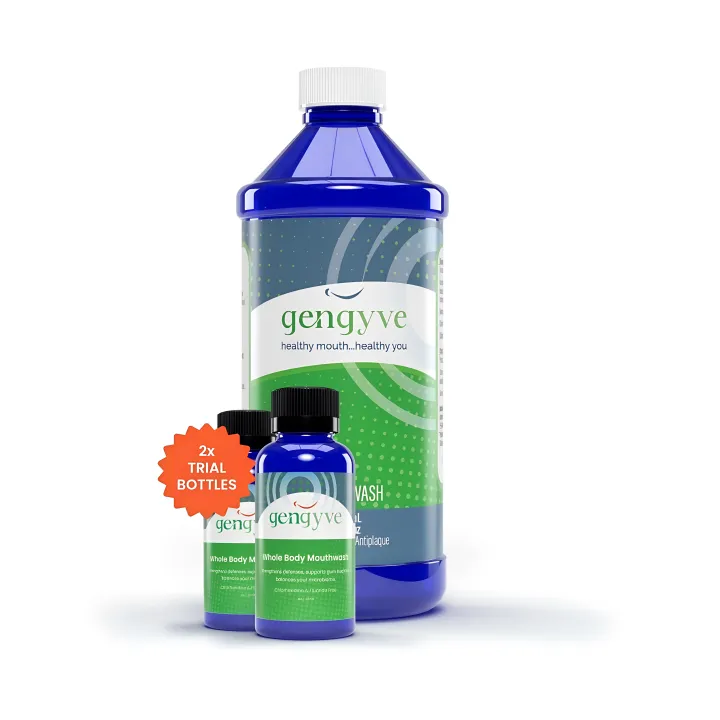
That comfort need is what Gengyve USA was built to address. Founded by a UCSF oral and maxillofacial surgeon, the company makes an alcohol-free, chlorhexidine-free rinse using CPC and hyaluronic acid for people who want something gentler on sensitive tissue.
It's a cosmetic oral rinse, not a treatment, cure, or cancer-prevention product, and it shouldn't be marketed or understood as one. For someone managing dry mouth, recovering from a dental procedure, or tired of the burn of traditional rinses, it's one option to discuss with a dentist, not a guaranteed health fix.

If you're dealing with active gum disease, recovering from oral surgery, managing radiation-related oral side effects, or experiencing severe dry mouth, talk to your dentist or medical team before switching products. Persistent symptoms deserve a professional opinion, not a product swap based on internet research.
What Oral Symptoms Should Not Be Ignored?
Regardless of what mouthwash sits in your bathroom cabinet, certain symptoms call for prompt evaluation. The National Institute of Dental and Craniofacial Research recommends seeing a dentist or doctor if any of these last more than two weeks:
- A mouth sore, lump, or thickened patch that doesn't heal
- A white or red patch inside the mouth
- Unexplained bleeding or pain
- Numbness in the tongue or another part of the mouth
- Difficulty chewing, swallowing, or moving the jaw
- Persistent hoarseness or a sore throat that won't resolve
- A neck lump
- Dentures that suddenly fit differently due to jaw or gum swelling
Most of these symptoms have causes other than cancer: infections, injuries, or irritation from dental work are common culprits. But persistence or progression shouldn't be self-treated with mouthwash, no matter how soothing the formula claims to be.
Routine mouthwash side effects like temporary burning, mild dryness, or a few hours of altered taste are different from the warning signs above. If a product causes significant, ongoing irritation, stop using it and ask your dentist for guidance, but don't confuse everyday discomfort with a red flag symptom.
Conclusion
The honest answer is a balanced one: alcohol mouthwash has not been proven to cause oral cancer, even after multiple large studies tried to find that link. People who experience dryness, burning, or lingering concern can reasonably discuss alcohol-free alternatives with their dentist, not because the science demands it, but because comfort matters too.
What actually moves the needle on oral-cancer risk is well established:
- Avoid tobacco
- Limit alcohol consumption
- Keep up with daily brushing and flossing
- Attend regular dental checkups
- Get any persistent oral change evaluated promptly
Mouthwash, whatever kind you choose, plays a supporting role in that routine, not a starring one.
Frequently Asked Questions
Why do some dentists not recommend mouthwash with alcohol?
Some dentists steer patients away from alcohol-containing rinses because of dryness, burning, or irritation, particularly for patients with sensitive tissue or dry mouth. This is a comfort-based recommendation specific to individual needs, not a universal cancer warning.
What is the leading cause of mouth cancer?
Tobacco use and heavy alcohol consumption are the most established risk factors for cancers in the mouth. HPV, particularly HPV-16, is a major factor for oropharyngeal cancers specifically, and risk profiles vary by location.
Is alcohol-free mouthwash safer?
Alcohol-free mouthwash is often more comfortable for people with dry mouth or sensitive gum tissue. "Safer" depends on the specific formula and your individual needs. It isn't proven to lower cancer risk.
Can mouthwash cause dry mouth or gum problems?
Some alcohol-containing rinses can worsen dryness or irritation in certain users, especially those already prone to dry mouth. Persistent gum bleeding, swelling, or pain should always be checked by a dentist.
Should I stop using alcohol-based mouthwash?
Don't switch products based on cancer fears alone. The evidence doesn't support that as a reason. Do talk to your dentist if you have dry mouth, irritation, specific risk factors, or a clinical reason to change your rinse.