The choice affects treatment outcome, daily comfort, staining, taste, product access, and whether a dentist needs to be involved. This guide covers how each ingredient works, when it's typically used, what the evidence shows, and why a rinse complements brushing, interdental cleaning, and professional care rather than replacing them.
Key Takeaways
- CPC is an over-the-counter daily-use ingredient; chlorhexidine 0.12% is prescription-only in the US.
- CHX cuts plaque substantially but brings staining, taste changes, and irritation.
- In trials where participants kept brushing, CPC and CHX did not differ significantly.
- No universal winner: match the rinse to your condition, duration, and dentist's guidance.
CPC vs Chlorhexidine: Quick Comparison
| Item | CPC rinse | Chlorhexidine 0.12% |
|---|---|---|
| US status | OTC monograph drug (for example, TheraBreath Healthy Gums) | Prescription drug (Peridex) |
| Labeled use | Helps prevent and control gingivitis and plaque | Gingivitis treatment between dental visits, within a professional program |
| Adult dose example | 20 mL for 30 seconds, twice daily | 15 mL undiluted for 30 seconds, twice daily |
| Duration | No fixed course; see a dentist if gum problems last beyond 2 weeks | No fixed maximum stated; reassessment at intervals of 6 months or less |
Doses vary by product, so always read the specific label. An ADA Seal applies to a particular product and its supported claims, not to every CPC formulation.


How they work
CPC is a cationic quaternary ammonium compound. Its positively charged head binds negatively charged bacterial membranes, and its hydrophobic tail disrupts them. The biofilm matrix can slow penetration, so membrane activity doesn't mean complete biofilm eradication.
Chlorhexidine (CHX) is also cationic and alters bacterial membrane permeability. It binds oral tissues and stays there, a property called substantivity that supports prolonged activity.
Tolerability and long-term use
CPC products are designed for regular use, provided you follow the label. Prolonged, unsupervised CHX use isn't appropriate; a dentist should set the length of any therapeutic course.
What Is Cetylpyridinium Chloride (CPC)?
CPC is a quaternary ammonium antimicrobial used as an active ingredient in oral rinses. It targets bacteria tied to plaque, gum inflammation, and bad breath.
What the research shows
A landmark 2008 review of 8 publications found small but statistically significant added reductions in plaque and gingival inflammation when CPC rinses supplemented brushing.
A 6-month randomized trial tested a 0.07% high-bioavailability CPC rinse in 139 adults with mild to moderate gingivitis. Compared with placebo, it showed 15.8% less plaque, 15.4% less inflammation, and 33.3% less bleeding. That result belongs to one formulation. It doesn't rank every CPC product.

For breath, a Cochrane review found low-certainty evidence from a single 70-person trial. Treat breath claims cautiously.
Safety and limitations
Longer CPC studies report staining, taste changes, burning, and mouth ulcers. Incomplete reporting and symptoms in placebo groups make a dependable adverse-event rate impossible to establish. Formula and duration matter.
Where CPC fits
CPC suits a daily routine for plaque control, gingivitis prevention, and control of odor-causing bacteria. It doesn't replace brushing, flossing, periodontal treatment, or a dental evaluation. After oral surgery or with active gum disease, use it only if your dental professional recommends it and sets the duration.
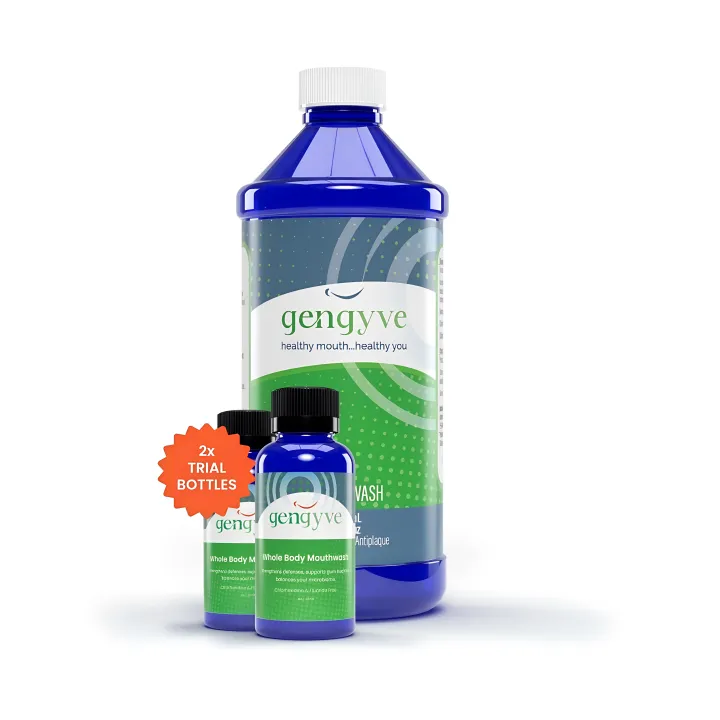
Gengyve's daily rinse is one example. It combines CPC with hyaluronic acid, and it's alcohol-free and chlorhexidine-free.
What Is Chlorhexidine (CHX)?
Chlorhexidine gluconate is a salt of chlorhexidine and gluconic acid used in oral rinses. The Peridex label lists 0.12% as the active concentration.
Clinical benefits and evidence
A Cochrane review of 51 studies and 5,345 participants found that CHX lowers plaque substantially. The Gingival Index fell by only 0.21 points at 4 to 6 weeks, and reviewers did not consider that clinically relevant for mild baseline inflammation.
Evidence for moderate or severe gingivitis is insufficient.
After tooth extraction, CHX 0.12% or 0.2% rinse lowered dry-socket odds (odds ratio 0.38) across 6 trials with 1,547 participants.
In a Chilean trial, dry socket occurred in 2.69% of CHX users versus 7.26% on placebo, using a 7-day course starting 24 hours after extraction. That's a studied surgical protocol, not a daily-use instruction.

Safety and duration
Documented effects include:
- Extrinsic staining after 4 or more weeks (56% of users versus 35% of controls at 6 months)
- Altered taste, with rare permanent cases reported
- Mucosal irritation, burning, and ulceration
- Increased supragingival calculus and, rarely, parotid swelling
- Serious allergic reactions, including anaphylaxis
Professional cleaning removes stain from most tooth surfaces, so this is surface discoloration, not a change to tooth structure. Rough restorations can hold stain stubbornly.
Spit it out and don't swallow. Seek immediate medical attention for generalized swelling or breathing difficulty.
Who should use it
CHX suits a defined clinical purpose, not default daily rinsing. Don't extend a course, substitute it for treatment, or share it without dental guidance. The label states its effect on periodontitis hasn't been determined.
CPC vs Chlorhexidine: Which Is Better for Your Needs?
"Stronger" doesn't mean "better." The right rinse depends on your goal, how long you'll use it, and your tolerance for side effects.
Situational recommendations
- Recovering from a procedure or managing a diagnosed condition: talk to your dentist about chlorhexidine.
- Seeking everyday plaque and breath support: consider a CPC rinse that matches its label and your tolerance.
- Concerned about staining: weigh that trade-off openly with your dentist.
Gengyve offers a CPC and hyaluronic acid mouthwash as a daily-use option. Staining and gentleness claims are the company's, so check the current bottle label for the full formula, directions, and warnings.
Decision checklist
- Check the active ingredient and its concentration.
- Note alcohol content.
- Decide how long you'll use it.
- Consider staining tolerance and taste sensitivity.
- Factor in age and health conditions.
- Confirm US regulatory status, such as OTC labeling or professional support.
What head-to-head research shows
A 6-week trial in Malaysia (Oo and colleagues) compared alcohol-free 0.05% CPC, 0.12% CHX, and placebo in 219 students who kept brushing. Both active rinses beat placebo for plaque and gingivitis, with no significant difference between them.
Taste changes and numbness were more common with CHX. The staining difference was not significant.
A 2025 meta-analysis found no significant CPC-CHX difference when brushing continued. Without brushing, CHX was favored. So CHX's edge doesn't translate into proven superiority alongside normal oral hygiene.

Gengyve also cites a 21-day, 75-student trial comparing its CPC-hyaluronic acid formulation, CHX, and placebo. Staining rose with CHX and placebo but not significantly with CPC-hyaluronic acid, and gingivitis differences weren't significant.
The study was short, funded by the formulation's manufacturer, and doesn't establish long-term superiority or show that mouthwash treats established periodontitis.
Pick by purpose, not ingredient strength. Dental practices and consumers comparing daily CPC options can review Gengyve's formula details and study summaries before choosing.
Conclusion
CPC is generally the better fit for everyday antimicrobial support. Chlorhexidine fits a defined, dentist-directed purpose such as a post-extraction protocol or a supervised gingivitis course.
The best choice depends on diagnosis, duration, formulation, and side-effect priorities. Either rinse is an adjunct to brushing and interdental cleaning, as the ADA notes. It never replaces them.
Frequently Asked Questions
Which is better, cetylpyridinium chloride or chlorhexidine mouthwash?
It depends on your goal. CPC may suit routine daily support, while chlorhexidine is chosen for a defined clinical indication under dental guidance.
Is salt water mouth rinse better than chlorhexidine?
Salt water soothes and helps flush debris, but it hasn't been shown to match chlorhexidine's antimicrobial or dry-socket-prevention effect. Don't use either in place of professional care for disease or post-operative concerns.
Is chlorhexidine the same as Listerine?
No. Chlorhexidine is an active ingredient. Listerine Original Antiseptic uses four essential-oil compounds (eucalyptol, menthol, methyl salicylate, thymol) and no chlorhexidine. Check each product's label.
What is chlorhexidine gluconate?
It's the salt form of chlorhexidine used in oral rinses. Follow the label or your dental professional's instructions.
What is the mechanism of action for chlorhexidine?
It binds oral surfaces and alters bacterial membrane permeability. Lower concentrations slow bacterial growth, while higher ones can cause cell death. It doesn't eliminate all bacteria.